
Portaking SEO Growth
From Product Website to Search-Led Growth Engine
Portaking operates in a highly commercial construction niche where potential customers rarely search for only one generic term. A buyer may search for a porta cabin, site office, portable toilet, security cabin, prefab house, container office, industrial shed, warehouse structure, or a specific size and configuration.
That made the SEO challenge much larger than ranking a homepage for a few broad keywords.
GeoScript Labs developed Portaking around a search architecture designed to capture demand at multiple stages of the customer journey. The strategy connected core product categories, individual product configurations, informational content, comparison topics, pricing-related searches, and location-focused pages into one structured organic search ecosystem.
The result was sustained growth in both visibility and clicks.
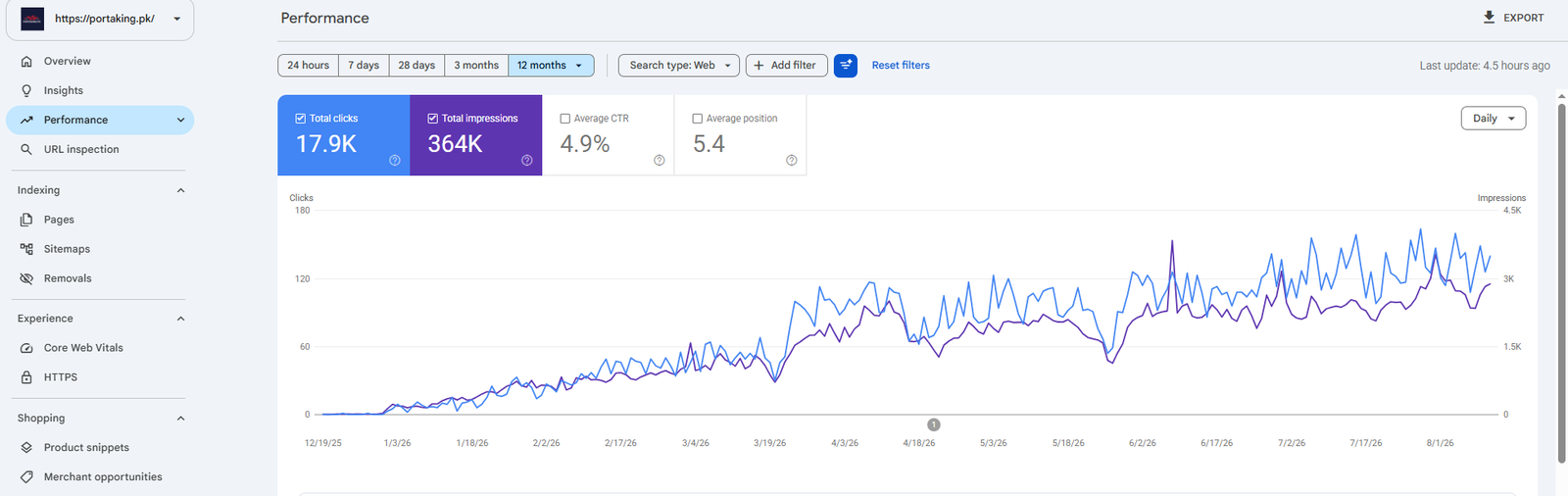
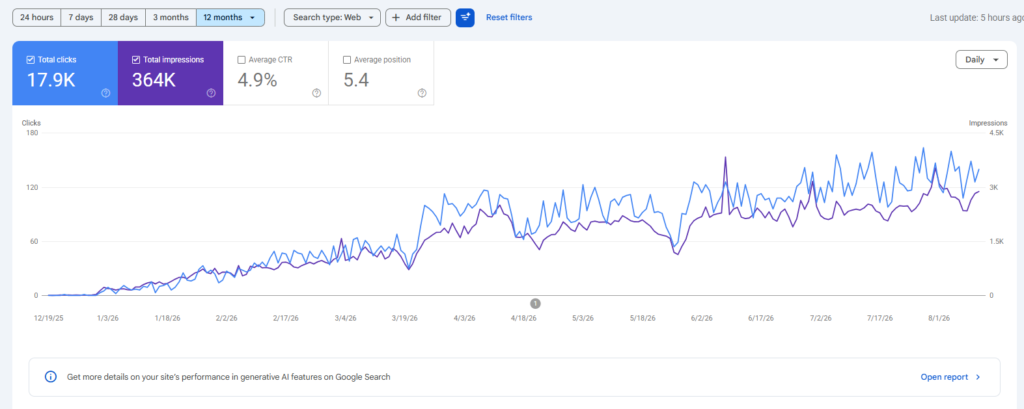
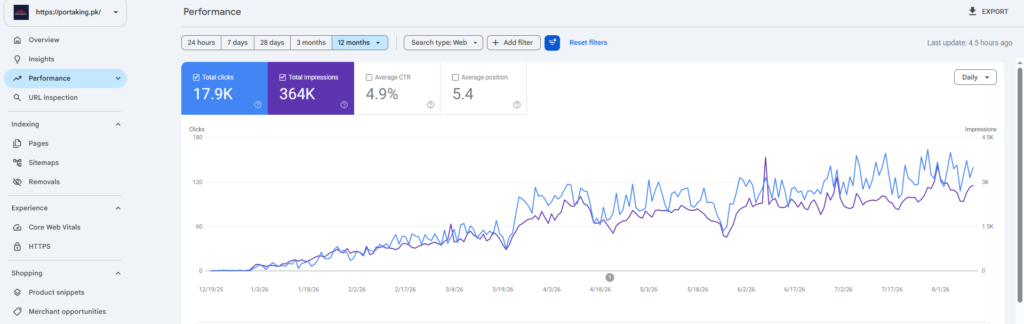
The latest Google Search Console performance data supplied for the project shows:
- 17,900 organic clicks
- 364,000 Google Search impressions
- 4.9% average click-through rate
- 5.4 average search position
More importantly, the performance graph shows growth occurring over time rather than being driven by one isolated traffic spike.
The Challenge
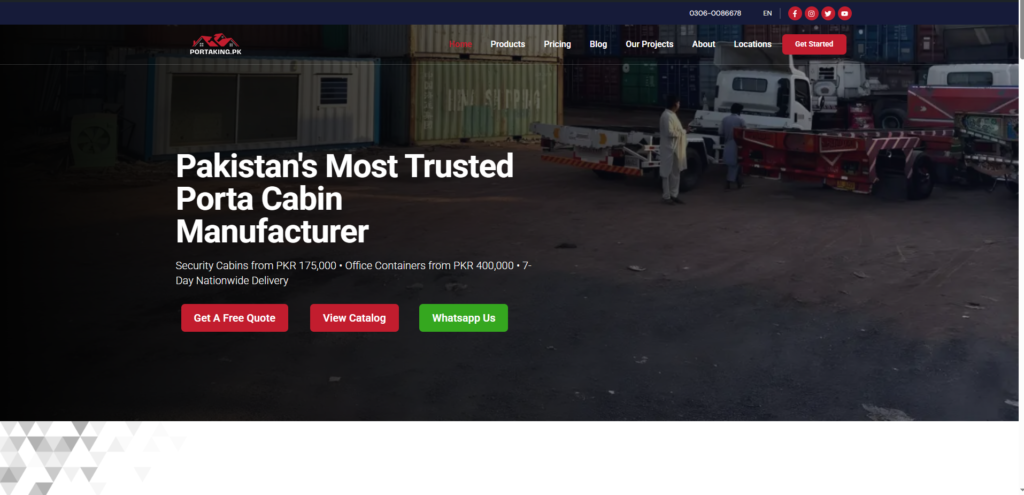
Portaking Had More Search Opportunities Than Its Existing Structure Could Capture
Prefab construction is not a single-keyword market.
Different customers search according to what they need, how much space they require, where the structure will be installed, what the structure will be used for, and how permanent or portable the solution needs to be.
A construction company may search for a temporary site office.
A factory may need a security cabin.
An event organizer may require portable washrooms.
A family may be researching prefab homes.
A warehouse or industrial operator may be comparing PEB structures with conventional construction.
Treating all of these visitors as one generic “porta cabin” audience would limit how much relevant organic demand the website could capture.
The project therefore required a broader search strategy that could support multiple commercial categories without creating disconnected pages or forcing every keyword onto the homepage.
Our Objective
The objective was not simply to increase traffic.
We wanted to build a website structure capable of attracting commercially relevant search demand across Portaking’s product categories while also creating enough informational depth for Google to understand the company’s expertise within prefab and portable construction.
The strategy focused on five goals:
- Build clear topical authority around Portaking’s main product families.
- Create stronger commercial pages for high-intent searches.
- Support those commercial pages with useful informational content.
- improve local and nationwide discoverability.
- Turn the website into a scalable SEO asset rather than a collection of isolated pages.
That required coordinated work across content, internal linking, technical SEO, page structure, local search, user experience, and conversion paths.
Building the Search Architecture
We Started With Search Intent, Not Blog Volume
Publishing large numbers of articles without a clear architecture can create more problems than it solves.
Pages may compete with each other.
Important commercial pages may receive little internal authority.
Google may have difficulty understanding which URL is the strongest answer for a particular query.
Instead of treating each keyword as a separate content idea, we organized the website around search intent and topical relationships.
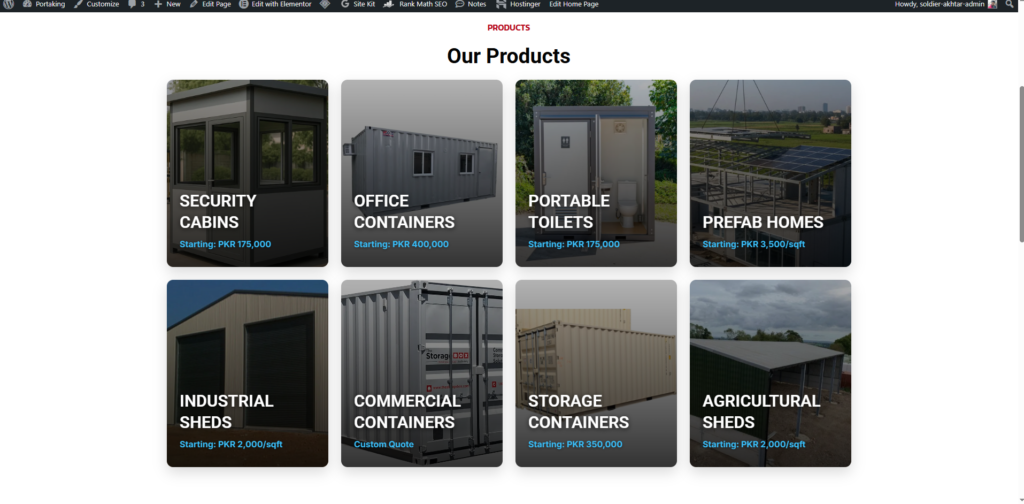
The main commercial areas were structured around product families such as:
- Porta cabins
- Office containers
- Security cabins
- Portable toilets
- Prefab homes
- Commercial containers
- Storage containers
- Industrial structures
- Agricultural structures
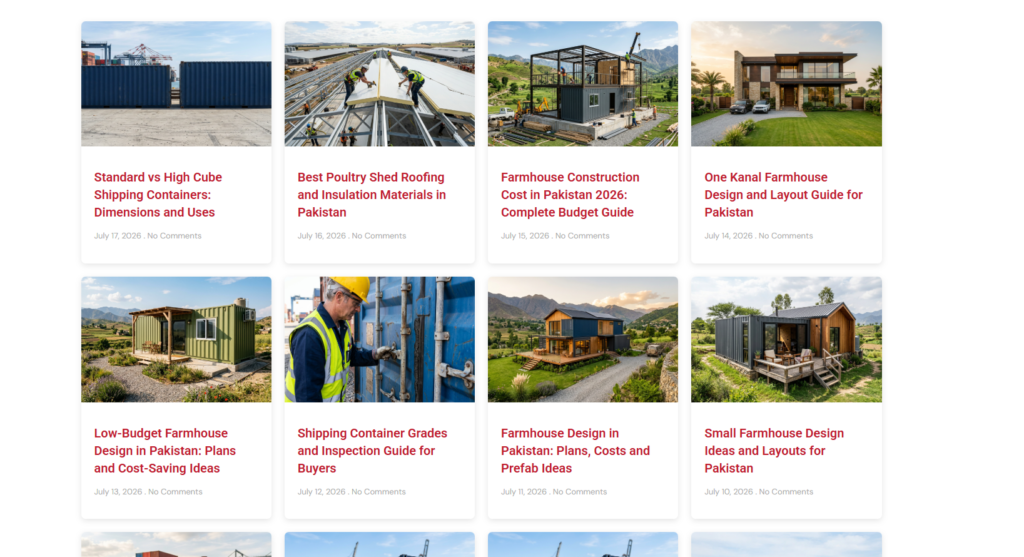
Supporting content was then designed around the questions customers naturally ask before purchasing those products.
This created a relationship between commercial intent and informational intent instead of allowing both to compete.
Semantic SEO and Topic Clusters
Each Major Product Became a Search Topic, Not Just a Sales Page
One of the largest parts of the campaign involved expanding Portaking’s topical coverage.
For example, a user researching a porta cabin may want to know:
- How much does a porta cabin cost?
- What affects the final price?
- How does it compare with concrete construction?
- What size is suitable?
- What materials are commonly used?
- How long does fabrication take?
- Is a cheaper unit worth buying?
- Can it be relocated later?
Those questions represent different stages of the same purchasing journey.
We therefore built supporting content around the commercial pages rather than publishing unrelated articles simply because keywords showed search volume.
The same approach was expanded into additional product clusters such as office containers, prefab housing, portable washrooms, industrial sheds, parking structures, and agricultural structures.
This allowed the website to cover broader semantic relationships while keeping every supporting article connected to a commercial purpose.
Commercial Page Optimization
Product Pages Needed to Answer Purchase Questions Directly
Ranking a product page is only useful when the visitor can understand what is being offered.
Commercial pages were therefore structured to provide substantially more information than a product image and contact button.
Depending on the product, pages were developed around information such as:
- Product dimensions
- Available configurations
- Typical applications
- Materials
- Insulation
- Interior specifications
- Electrical provisions
- Optional upgrades
- Delivery information
- Installation
- Warranty information
- Related sizes
- Comparison information
- Frequently asked questions
- Quote and WhatsApp actions
For example, Portaking’s office-container section now includes multiple size-specific commercial pages rather than forcing customers looking for an 8×10, 8×20, or 8×40 workspace onto one generic page.
This creates stronger intent matching while giving visitors more information before they contact the business.
Internal Linking Strategy
Content Was Designed to Move Authority and Users Toward Commercial Pages
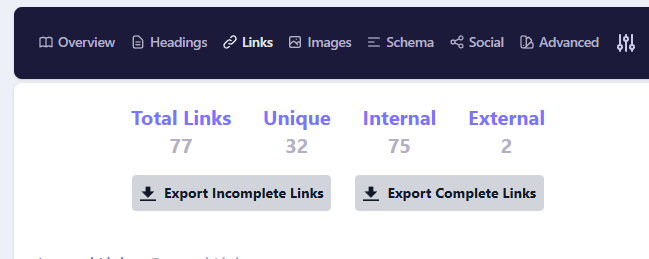
Internal linking played an important role in the project.
A common SEO problem occurs when a website publishes dozens of useful blogs but leaves its most commercially valuable pages isolated.
We structured links so supporting articles could naturally point users toward:
- Relevant product categories
- Product configurations
- Related buying guides
- Comparison articles
- Pricing information
- Location pages
- Quote and contact opportunities
At the same time, commercial pages could point visitors toward educational resources when more explanation was useful.
The goal was to create logical pathways rather than inserting links simply because two pages happened to contain similar keywords.
A visitor reading about container-office costs, for example, should be able to continue naturally toward available office-container sizes or request a quote.
That same relationship also helps search engines understand how URLs within a topic are connected.
Local SEO and Geographic Search Visibility
A Nationwide Business Still Needs Local Relevance
Portaking serves customers across Pakistan, but people frequently search for construction products with geographic intent.
Searches may include a city, province, delivery area, or phrases such as “near me.”
We therefore treated local SEO as a supporting layer of the broader organic strategy.
Location-focused content was built around areas where Portaking could genuinely serve customers. These pages were not created simply by changing a city name inside otherwise identical copy.
Where relevant, location pages could communicate:
- Available products
- Delivery considerations
- Service coverage
- Local project requirements
- Relevant use cases
- Contact information
- Manufacturing or delivery context
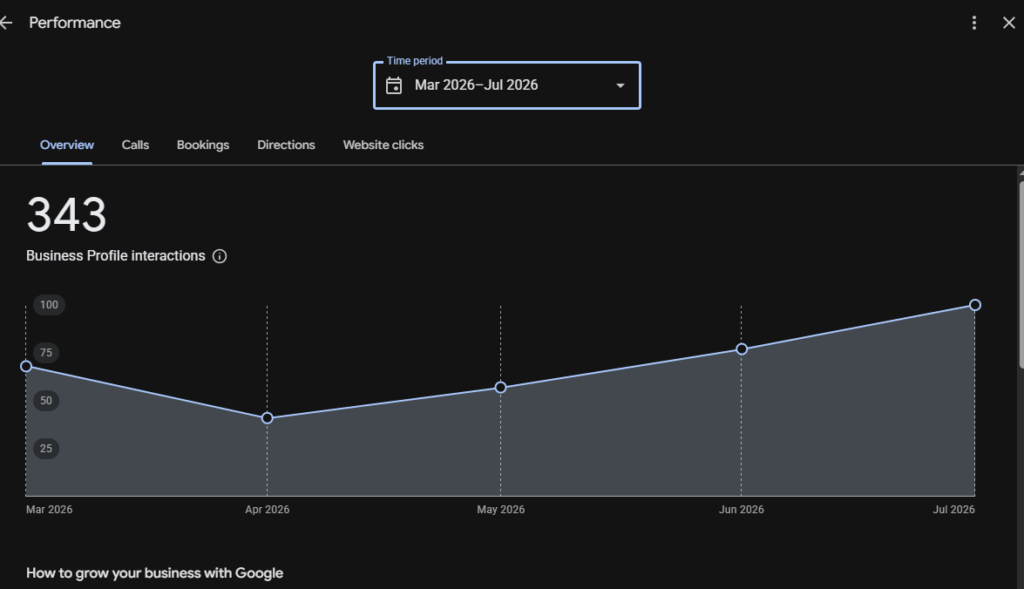
Google Business Profile optimization complemented the website strategy by strengthening Portaking’s presence for searches where Maps and local results influence the customer journey.
Technical SEO
Content Growth Required a Clean Technical Foundation
Expanding a website also increases technical complexity.
More categories, product pages, articles, images, internal links, and location pages create more opportunities for indexing issues and duplication.
Technical SEO work therefore supported the content strategy.
Areas monitored or improved during the project included:
- Crawlability
- Indexation
- XML sitemaps
- URL structure
- Canonical signals
- Redirects
- Internal linking
- Breadcrumbs
- Page hierarchy
- Metadata
- Structured data
- Image optimization
- Mobile usability
- Core performance
- Search Console coverage
The purpose was straightforward: valuable content cannot generate consistent organic visibility if search engines struggle to discover, interpret, or index it correctly.
Content Strategy
We Built Content Around Decisions Customers Actually Make
The content strategy moved beyond generic subjects such as “What Is a Porta Cabin?”
A customer close to making a purchase typically asks more specific questions.
For example:
Which option costs more?
What size do I need?
Is a portable office suitable for a construction site?
Should I use a prefab structure or conventional construction?
What affects the price?
Which material is suitable for Pakistan’s climate?
These questions became opportunities to build useful supporting content while attracting users earlier in the buying process.
The goal was to create content that could rank independently while still contributing to Portaking’s wider commercial search ecosystem.
Search Results
364,000 Search Impressions
The website generated 364K impressions in the supplied Google Search Console performance report.
Impressions measure how often pages from Portaking appeared in Google Search results.
For this project, the number is particularly useful because the strategy was designed to increase the breadth of queries and topics for which the site could appear.
Greater impression coverage meant Portaking was no longer depending on only a small group of keywords for search visibility.
17,900 Organic Clicks
Visibility ultimately needs to produce visits.
The same Search Console report recorded 17.9K organic clicks.
The performance graph shows the click trend developing progressively, with later periods generating significantly more daily clicks than the beginning of the available reporting window.
This matters because sustained SEO growth is more valuable than a short-lived spike produced by one viral article or temporary ranking.
The website was increasingly attracting users across a broader search footprint.
4.9% Organic Click-Through Rate
Portaking maintained an average 4.9% CTR in the supplied report.
CTR measures the percentage of search impressions that resulted in a click.
Search visibility alone does not guarantee traffic. Pages must also appear relevant enough for users to choose them from the results.
Page titles, search intent alignment, product specificity, and useful commercial information all contribute to that decision.
5.4 Average Search Position
The supplied Search Console report shows an average position of 5.4.
Average position should never be interpreted as every keyword ranking fifth. Search Console combines performance across many queries, pages, locations, and devices.
However, maintaining an overall position around the first page while generating hundreds of thousands of impressions indicates that the website had developed meaningful visibility across its tracked search footprint.
What Made the Growth Work?
There was no single “SEO trick.”
The result came from connecting multiple parts of the website.
01. Clear Commercial Architecture
Instead of relying primarily on a homepage, the website developed dedicated commercial destinations for distinct products and customer needs.
02. Semantic Topic Development
Supporting content was organized around subjects and buying journeys rather than random keyword opportunities.
03. Intent-Based Content
Informational articles answered questions users were genuinely asking while preserving transactional intent for service and product pages.
04. Internal Linking
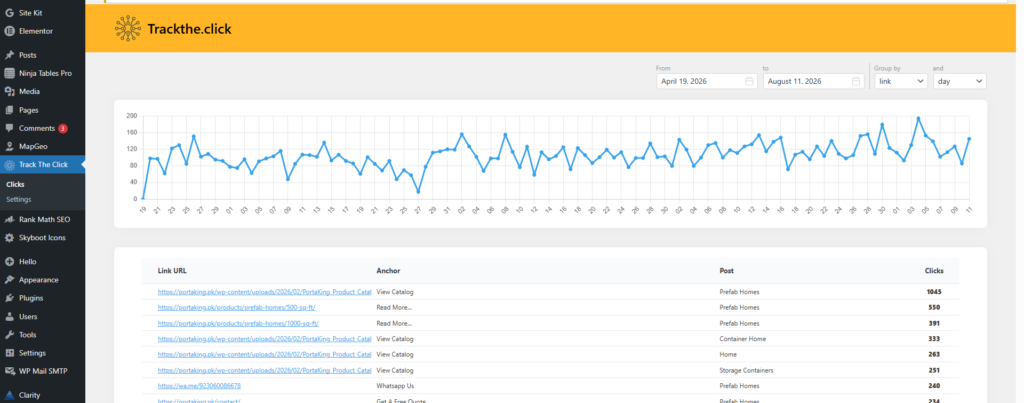
Supporting pages were connected back to relevant commercial destinations, helping users and search engines navigate the site’s topical structure.
05. Technical SEO
Indexability, hierarchy, metadata, structured relationships, and other technical foundations were treated as part of the strategy rather than an afterthought.
06. Local Visibility
Website SEO and Google Business Profile work supported geographic discovery alongside nationwide organic visibility.
07. Continuous Measurement
Google Search Console data was used to identify growth, declining queries, new opportunities, page performance, and areas requiring further optimization.
More Than Traffic: Building a Search Asset
The most important outcome of the Portaking project is not one ranking or one article.
It is the search infrastructure created around the business.
A strong commercial website should become more valuable as its search ecosystem develops.
New product pages can connect to established topics.
New articles can support existing commercial categories.
New geographic pages can inherit contextual relevance from the wider website.
Existing pages can be improved using real query data.
That is significantly more scalable than repeatedly creating disconnected landing pages and hoping individual keywords rank.
Portaking developed from a website representing a prefab manufacturer into a growing search asset capable of addressing commercial, informational, product-specific, and geographic demand.
The Result in Numbers
17.9K
Organic Clicks
Visits generated directly from Google Search in the supplied reporting view.
364K
Search Impressions
Appearances across Google Search results.
4.9%
Organic CTR
Average click-through rate across the measured search performance.
5.4
Average Position
Average Google Search position across the site’s query footprint in the supplied report.
What We’re Continuing to Improve
SEO growth does not end once a website reaches the first page.
As Portaking’s search footprint expands, the next phase focuses on strengthening the areas already demonstrating commercial potential while opening additional opportunities.
Ongoing work includes:
- Expanding high-value topical clusters
- Strengthening product-category authority
- Improving existing rankings sitting near top positions
- Refreshing content using Search Console query data
- Improving internal links between related topics
- Expanding meaningful geographic visibility
- Strengthening entity and structured-data signals
- Improving visibility within AI-assisted search experiences
- Increasing conversion opportunities from existing organic traffic
- Publishing more project-based proof and first-party expertise
The strategy shifts progressively from simply creating visibility to extracting more value from the visibility already earned.
Why This Case Study Matters
Portaking demonstrates what happens when SEO is treated as website infrastructure rather than a checklist.
The project combined technical foundations, commercial page development, semantic content, internal linking, local search, and ongoing performance analysis.
Instead of attempting to rank every term using a small number of generic pages, the website was developed into interconnected search pathways designed around actual customer needs.
That foundation has produced measurable organic growth and gives the brand room to continue expanding without rebuilding its SEO strategy every time a new product or market opportunity is introduced.
Build a Search System That Compounds
Your website should do more than exist when someone searches for your company name.
It should help your business appear when customers are researching their problem, comparing solutions, checking costs, evaluating options, and preparing to contact a supplier.
GeoScript Labs builds search systems designed around that complete journey.
Want to see what your website is currently missing?
Get Your Free Visibility Audit
We will review your search structure, technical foundations, content coverage, local visibility, and opportunities across traditional and AI-powered search.
Explore the capabilities behind this work
Continue with the service, market or proof page most closely related to what you are reading.
Have a similar challenge?
Share the goal, current setup and constraints. We will help you turn it into a practical scope.